“I Figured out How Strong I Really Am”: Penny Schultz on the Navy and What It Gave Her
In 1983, Penny Schultz became one of the first women to work as a torpedoman at the naval base in Keyport, Washington. Today she is on the pricing team at Engage fi.
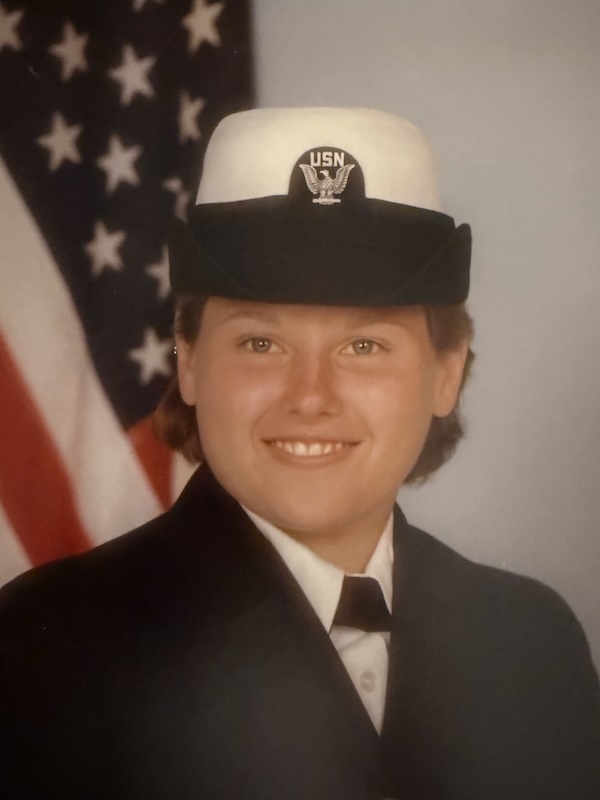
Penny Schultz and her friend Dana had just picked their first set of orders when their squad leader gave them a warning. “I hope you are strong, ladies,” he said. “You’re in for a surprise.”
It was 1983. The two of them were headed to the naval base in Keyport, Washington, to work as torpedomen, a job that had only recently opened to women. They would be the second and third women to be stationed there.
Penny hadn’t joined the Navy with torpedoes in mind. She grew up in a small, rural town in Wisconsin, the daughter of a self-employed cabinet maker, and she wanted to go to college. “There wasn’t such a thing as college funds back then,” she said. “If I went to college, I had to work my way through it. So I looked to the military for that option.” Recruits took a test and were given a job. Nobody got to pick.
Boot camp came first, and it surprised her. “I was never a physical kid. I didn’t play sports or anything like that,” she said. “I got in there and I was like, man, I can’t do this, and they’re like, well, you have to do this.” She did. “I figured out how strong I really am, and it gave me the foundation to move forward in my life.”
Keyport was hard in a different way. When Penny and Dana walked into a room, everyone went quiet. For about a year, the men on their crews barely talked to them.
The job didn’t leave room for that to last. Penny’s crew tested the electrical systems on torpedoes, then launched them on runs of three or four hours to see whether they went where they had been programmed to go. Getting one into the water meant chaining it up, forklifting it off the truck, and loading it onto the boat and into the launcher. “There was nothing one person could have done,” she said.
Somewhere in that first year, the silence turned into something else. Penny and Dana were the ones who always had snacks on the boat, and the guys knew it. When the crew rotated up to the base in Canada, they rented condos and took turns cooking for everyone. “It became more of a brother-sister thing,” Penny said. “They became very protective of us.”
That mattered more than she expected. Her father had moved the family away from their relatives when she was two, so she grew up without cousins down the street or weekends at her grandmother’s. The Navy gave her that. She went to her crewmates’ kids’ birthday parties and was there when their babies were born. “It was a family outside of your family,” she said.
The memory she holds onto most is the day her master chief retired. In the Navy’s retirement ceremony, sailors form two lines of three and salute the retiree as he walks between them. At the end of the line, he takes off his hat and becomes a civilian. The retiree chooses the six, and he chose Penny and Dana as two of the six. She called it an honor.
When Penny left the Navy after four and a half years on active duty, she went into banking, starting in a basement sorting checks, a job “nobody knows ever happens.” By the time she left banking for consulting, she was a director over several departments and reported directly to the CEO. She didn’t bring any technical skills from the Navy into that career. She brought something else. “They gave me the work ethic, the stamina, and the will to keep doing it,” she said.
People she has just met still ask whether she served. “Everything in its place, everything has its order,” she said. “Do it right the first time.”
Andres Pasantes, Engage fi’s CEO, has seen that firsthand. “From the day I hired Penny, I have seen the strength, discipline, and determination that her service helped shape. She brings that same leadership, work ethic, and pride to our clients and our team every day. I am personally grateful for her service to our country and proud to call her a teammate.” When he hands Penny a project, he knows she’ll take it the whole way on her own, and he doesn’t need to check in. “If he hears from me, something’s gone wrong,” she said, “because I figure it out.”
Andres asked about her military background the day he hired her four years ago, and he has made a point of thanking her for her service ever since. That recognition from her CEO matters to her. “Something as simple as that,” she said, “it just makes you feel good.”
For Penny, Veterans Day isn’t a celebration. “It’s a remembrance for me,” she said. “It just makes me stop and think and remember.” She thinks about the people she served with and wonders what they’re doing now. She and Dana still talk, more than forty years after walking into a unit where few expected them to belong. “We have that history that no one else knows,” she said.
Asked whether she would serve again, she didn’t hesitate. “I would do it again. I would do it differently, but I don’t regret ever doing it.”
Penny, thank you for your service.
This is the first of three Carried Forward stories from across Uplift and our portfolio companies.
About Engage fi
Engage fi is a technology-enabled consulting and advisory firm that helps banks and credit unions make smarter, faster technology and vendor decisions, from evaluations and contract negotiations to conversions, mergers, and implementations. Learn more at www.engagefi.com.